Overview
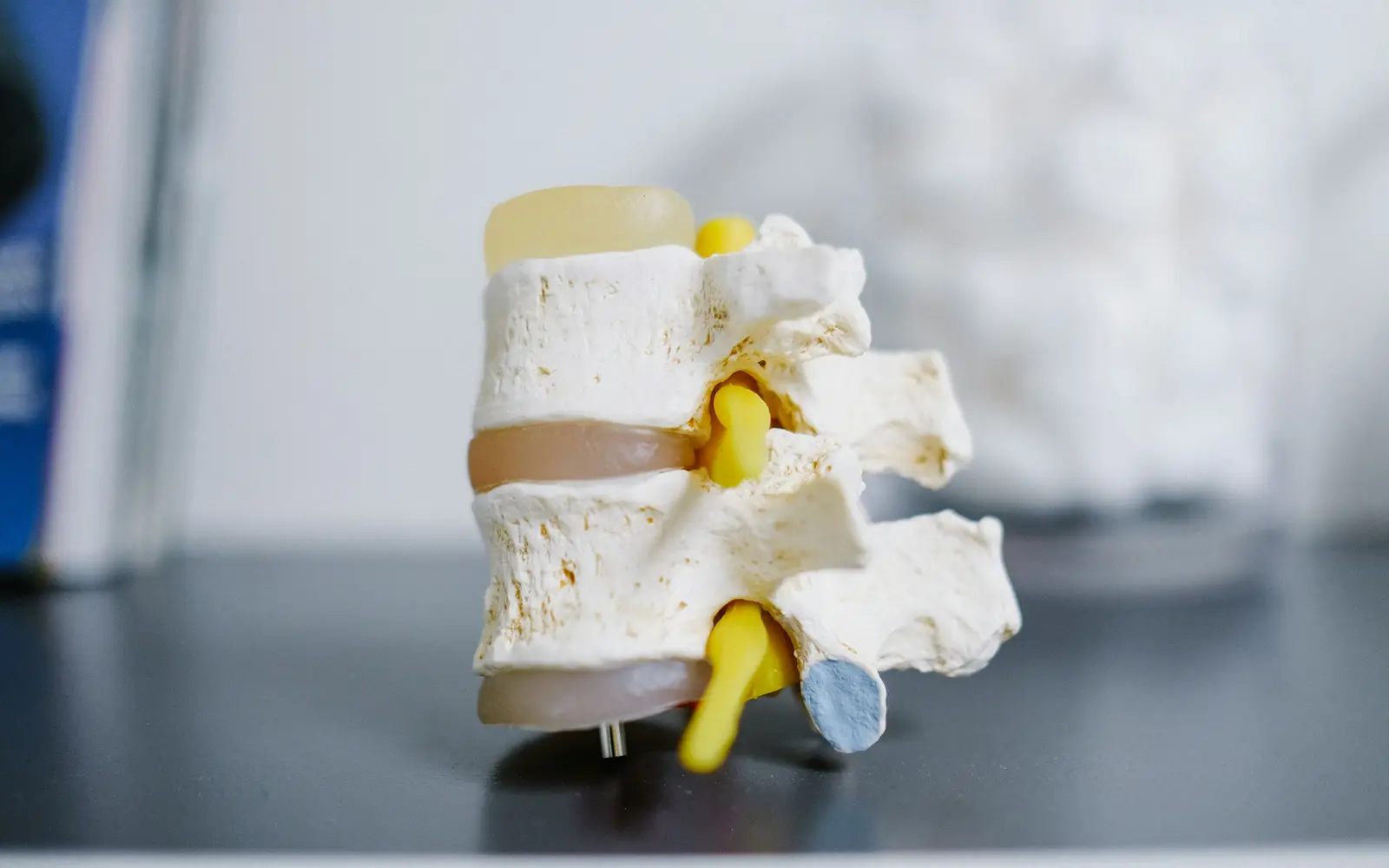
Spinal fusion is an operation that joins two or more vertebrae (the bones that stack up to form your spine) so that they heal into one solid piece of bone. When a segment of the spine moves in a way it should not, it can press on nerves and cause pain in the back, neck, arms or legs. Fusing that segment stops the movement.
The surgeon places bone graft, or a bone substitute, between the vertebrae and holds them still with metal screws and rods while the bone grows across. That bone growth takes months. The screws and rods do the holding work in the meantime, which is why you can usually walk the day after surgery even though the fusion itself is not yet solid.
Fusion is often combined with decompression, meaning the surgeon also removes whatever is pressing on a nerve. That might be a laminectomy (removing the lamina, the thin plate of bone at the back of a vertebra) or a discectomy (removing the damaged part of a disc, the cushion between two vertebrae).
When you ask MediCurage for help, you can name a preferred country or let partner hospitals in several countries see your reports. Each one quotes for your case, and you decide where to have the surgery.
Who needs it
Fusion is not a first treatment for back pain. Most people with back or neck pain get better with medicines, physiotherapy and time. Surgeons consider fusion when there is a clear structural problem that the scans can show, and when other treatment has not helped. Common reasons include:
- Spondylolisthesis: one vertebra has slipped forward over the one below it, narrowing the space for the nerves.
- Instability: X-rays taken while you bend forward and backward show a segment moving more than it should.
- Spinal stenosis with instability: the canal holding the nerves has narrowed, and removing bone to free the nerves would leave the spine unstable without a fusion.
- Cervical myelopathy: pressure on the spinal cord in the neck, causing clumsy hands, numbness or an unsteady walk.
- Fractures, deformity, infection or tumours that have damaged the structure of the spine.
- A disc problem that has come back after an earlier operation at the same level.
Reports the surgeon will want
Send what you have, even if it is a few years old. The surgeon will usually ask for:
- An MRI of the affected part of the spine, with the radiologist's report. MRI shows discs, nerves and the spinal cord. The report will mention findings such as "disc bulge", "canal stenosis" or "nerve root compression", and the surgeon checks whether these match your symptoms.
- Standing X-rays of the spine, ideally with flexion and extension views (taken while you bend forward and lean back). Standing films show how the spine behaves under your body weight, which a lying down MRI cannot.
- A CT scan if available, to look at the bone in detail.
- Nerve conduction studies or EMG (tests of how well nerves and muscles carry electrical signals), if you have leg or arm weakness or numbness.
- A bone density scan (DEXA) for older patients, since screws need firm bone to hold.
- Blood sugar results if you have diabetes, and a list of your current medicines, especially blood thinners.
How it is done
The operation is done under general anaesthesia. It usually takes two to five hours, depending on how many levels are fused.
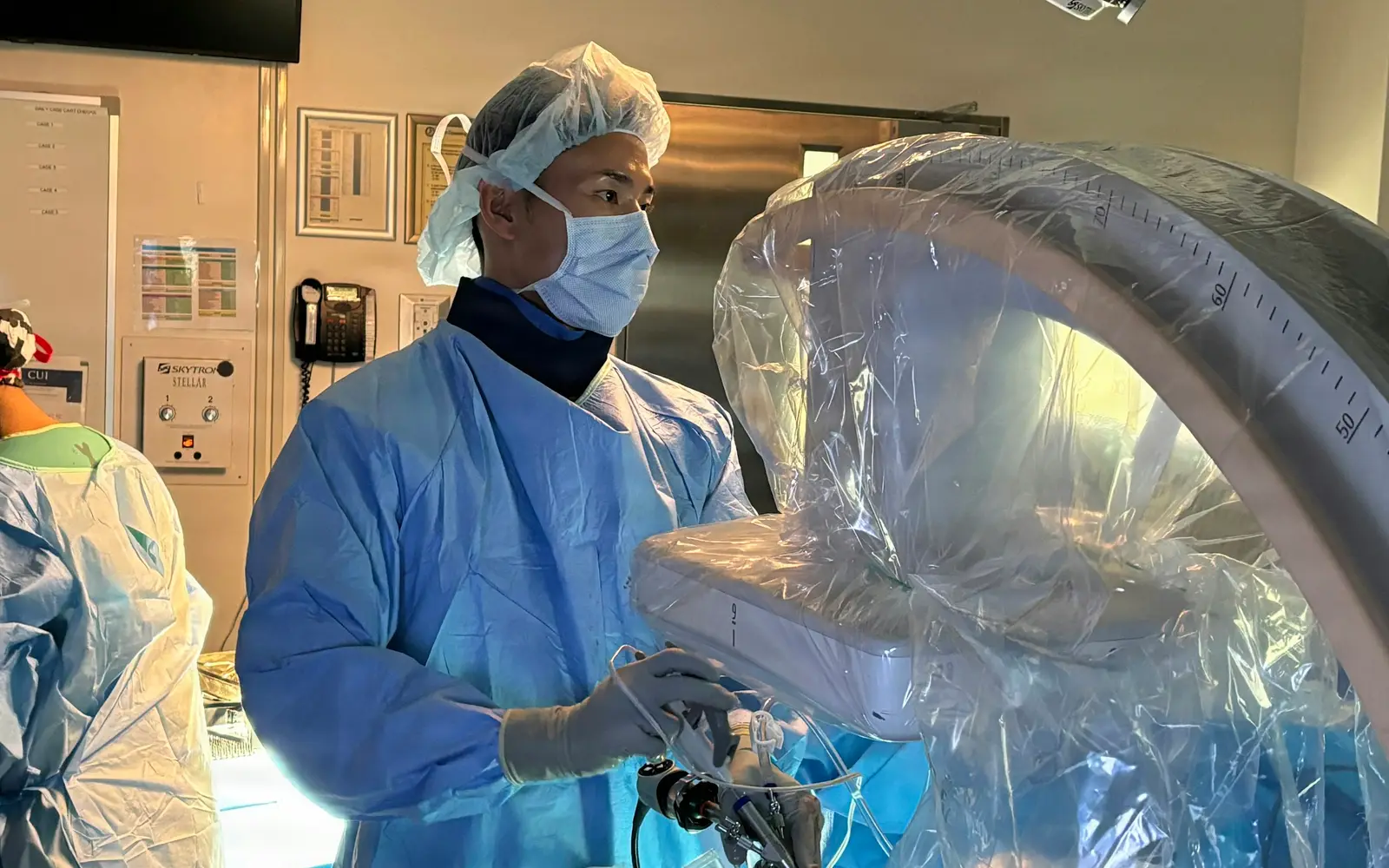
In the lower back the most common approach is from behind, with you lying face down. The surgeon makes a cut along the middle of the back, moves the muscles aside, frees any trapped nerves, and then places screws into the vertebrae, connected by rods. Many surgeons also remove the disc and insert a cage (a small spacer filled with bone graft) into the disc space. You may see this called TLIF or PLIF, which are names for the angle the cage goes in. Some fusions are done through smaller cuts with special tubes and X-ray guidance; our page on minimally invasive spine surgery explains that approach.
In the neck the usual operation is an ACDF (anterior cervical discectomy and fusion). The surgeon goes in through a small cut at the front of the neck, removes the disc pressing on the cord or nerves, and fills the gap with a cage and a small plate.
Many hospitals use neuromonitoring during spine surgery. Small electrodes on your skin and scalp track the signals travelling along the spinal cord and nerves, and warn the team at once if anything changes. X-rays taken during the operation confirm each screw is in the right place.
You wake up with a dressing on the wound, often a thin drain tube to remove fluid, and sometimes a urinary catheter for the first day.
Recovery and how long you stay
A physiotherapist will usually help you stand and walk on the first or second day. Walking early lowers the risk of blood clots and chest infection. The drain and catheter normally come out within a day or two.
Expect about 4 to 6 days in hospital after a lower back fusion, a little less after a single level neck fusion. You go home when you can walk safely, use the toilet on your own and manage pain with tablets.
For the next few weeks, surgeons usually advise walking often and avoiding bending, heavy lifting and twisting, and your own surgeon gives the exact limits. Your physiotherapist will show you how to get out of bed and sit down without straining the spine. The stitches or clips usually come out after 10 to 14 days.
Most patients stay about 3 to 4 weeks in total in the country where they are treated. That covers tests before surgery, the hospital stay, a wound check, and a review with the surgeon who confirms you can sit through a long flight. For the flight, many surgeons suggest an aisle seat, a short walk about once an hour and plenty of water. The bone itself keeps healing for 6 to 12 months, and your surgeon will want follow up X-rays during that time, which you can have done at home and share with the team.
MediCurage arranges the stay and the hospital carries out the surgery. After a fusion, low sofas and stairs are hard for a few weeks, so we look for a room near the hospital with a lift and a chair of normal height, and after you go home your coordinator makes sure the follow up X-rays reach your surgeon.
Questions to ask your surgeon
Write these down before your online consultation or first appointment:
- How many levels do you plan to fuse, and why those levels?
- Will you remove any bone or disc to free the nerves, and which symptoms do you expect that to help?
- Will you use a cage, and where will the bone graft come from?
- Will neuromonitoring be used during my operation?
- How much movement will I lose in my back or neck?
- Will I need a brace, and for how long?
- My bone density or blood sugar is not ideal. Does that change the plan?
- When can I sit through a long flight, and when should my first follow up X-ray be done?
- Which symptoms after I get home mean I should call you straight away?
If one surgeon's answers differ from another's, that is useful to know. You can put the same questions to doctors at more than one partner hospital before you choose, and your coordinator can join the call with an interpreter so nothing gets lost.
Indicative cost by country
Ranges for a standard case at a private hospital. They help you plan; your chosen hospital's quote for your case is the figure to plan around.
- IndiaIndicative priceUS$5,500 to US$9,000Hospital stay4 to 6 daysTotal time in the country21 to 28 days
What the range usually covers: One-level fusion with screws and cage, surgeon and anaesthesia fees, and the listed hospital days. Each extra level adds to the cost. Excludes flights and hotel.
- TurkeyIndicative priceUS$9,000 to US$18,000Hospital stay4 to 6 daysTotal time in the country21 to 28 days
What the range usually covers: One-level fusion with screws and cage, surgeon and anaesthesia fees, and the listed hospital days. Each extra level adds to the cost. Excludes flights and hotel.
- ThailandIndicative priceUS$20,000 to US$28,000Hospital stay4 to 6 daysTotal time in the country21 to 28 days
What the range usually covers: One-level fusion with screws and cage, surgeon and anaesthesia fees, and the listed hospital days. Each extra level adds to the cost. Excludes flights and hotel.
- MalaysiaIndicative priceUS$12,000 to US$20,000Hospital stay4 to 6 daysTotal time in the country21 to 28 days
What the range usually covers: One-level fusion with screws and cage, surgeon and anaesthesia fees, and the listed hospital days. Each extra level adds to the cost. Excludes flights and hotel.
- MexicoIndicative priceUS$11,500 to US$20,000Hospital stay4 to 6 daysTotal time in the country21 to 28 days
What the range usually covers: One-level fusion with screws and cage, surgeon and anaesthesia fees, and the listed hospital days. Each extra level adds to the cost. Excludes flights and hotel.
Indicative range. Your final cost depends on your reports and the hospital you choose.
Questions families ask
Will I be able to bend after a spinal fusion?
A fusion of one or two levels in the lower back usually leaves most of your bending ability intact, because the joints above and below still move. A longer fusion takes away more movement. Your surgeon can tell you what to expect for the number of levels planned in your case.
How soon can I fly home after spinal fusion?
Most surgeons want to check the wound and see you walking well before a long flight, which is usually two to three weeks after surgery. Surgeons generally suggest walking the aisle often during the flight and drinking plenty of water. Your surgeon gives the final clearance.
Do I need to wear a brace after the operation?
Some surgeons use a soft or rigid back brace for a few weeks, others do not use one at all. It depends on the type of fusion and the quality of your bone. Ask before you travel so you can plan for it.
Which reports should I send for a spinal fusion quote?
Send your latest MRI with the radiologist's report, standing X-rays of the spine (bending views if you have them), any CT scan, and a short note of your symptoms and past treatment. Nerve conduction studies and a bone density scan help if you already have them. The quote depends on how many levels need fusing, so clear scans make the quotes more accurate.
Can someone from my family stay with me in hospital?
Most hospitals allow one attendant to stay in the patient's room. Your coordinator confirms the rules of the hospital you choose and arranges a stay nearby for anyone else travelling with you.
This page is general information. Your treating doctor decides your treatment plan.