Overview
Of all the heart treatments on this site, angioplasty usually needs the least time away from home. Many patients are in hospital for a single night and on a flight back within a week. That makes it a practical option for a working parent, or for a family that cannot leave a business or other children for long.
Coronary angioplasty treats narrowed coronary arteries, the vessels that carry blood to the heart muscle. Doctors also call it PCI (percutaneous coronary intervention) or PTCA. A thin, flexible tube called a catheter is passed through an artery in the wrist or groin up to the heart. A tiny balloon at its tip is inflated inside the narrowed section to push the fatty deposit, called plaque, against the artery wall.
Almost always, the cardiologist then places a stent. This is a small tube of metal mesh that holds the artery open. Most stents used today are drug eluting stents, coated with a medicine that is slowly released to reduce the chance of the artery narrowing again.
Who needs it
Angioplasty is usually advised for people with:
- angina (chest pain or tightness on effort) that continues despite medicines
- one or two narrowed arteries where a stent can reach and work well
- a recent heart attack, once the patient is stable, to treat narrowings that remain
- a positive stress test or other signs that part of the heart is short of blood
Some patterns of disease are often better treated with bypass surgery. These include narrowing in many arteries at once, especially with diabetes, and some narrowings of the left main artery. Your reports go to cardiologists and cardiac surgeons, and they may disagree about which is better for you. Reading both opinions is worth the time.
One point needs to be clear. A heart attack happening now is an emergency. The treatment for it is angioplasty at the nearest capable hospital, within hours, and not a trip abroad. Travel for angioplasty makes sense when the condition is stable and the procedure can be planned.
How it is done
Before the procedure
On arrival day or the next morning, expect blood tests (kidney function matters because of the contrast dye used in the X-rays), an ECG, an echocardiogram (an ultrasound scan of the heart), and a review by the cardiologist. If you take metformin for diabetes, you may be asked to pause it around the procedure. Tell the team if you have ever reacted badly to contrast dye during an earlier scan or angiogram.
Many patients come with an angiogram already done at home. If it is recent and clear, the cardiologist may plan straight from it. If not, a fresh coronary angiogram is done first, which is an X-ray video of the heart arteries taken while dye is injected. Often the angiogram and the angioplasty happen in the same sitting, so the cardiologist will ask for your consent to go ahead with stenting if the pictures show it is needed. Discuss this before the day.
In the catheter laboratory
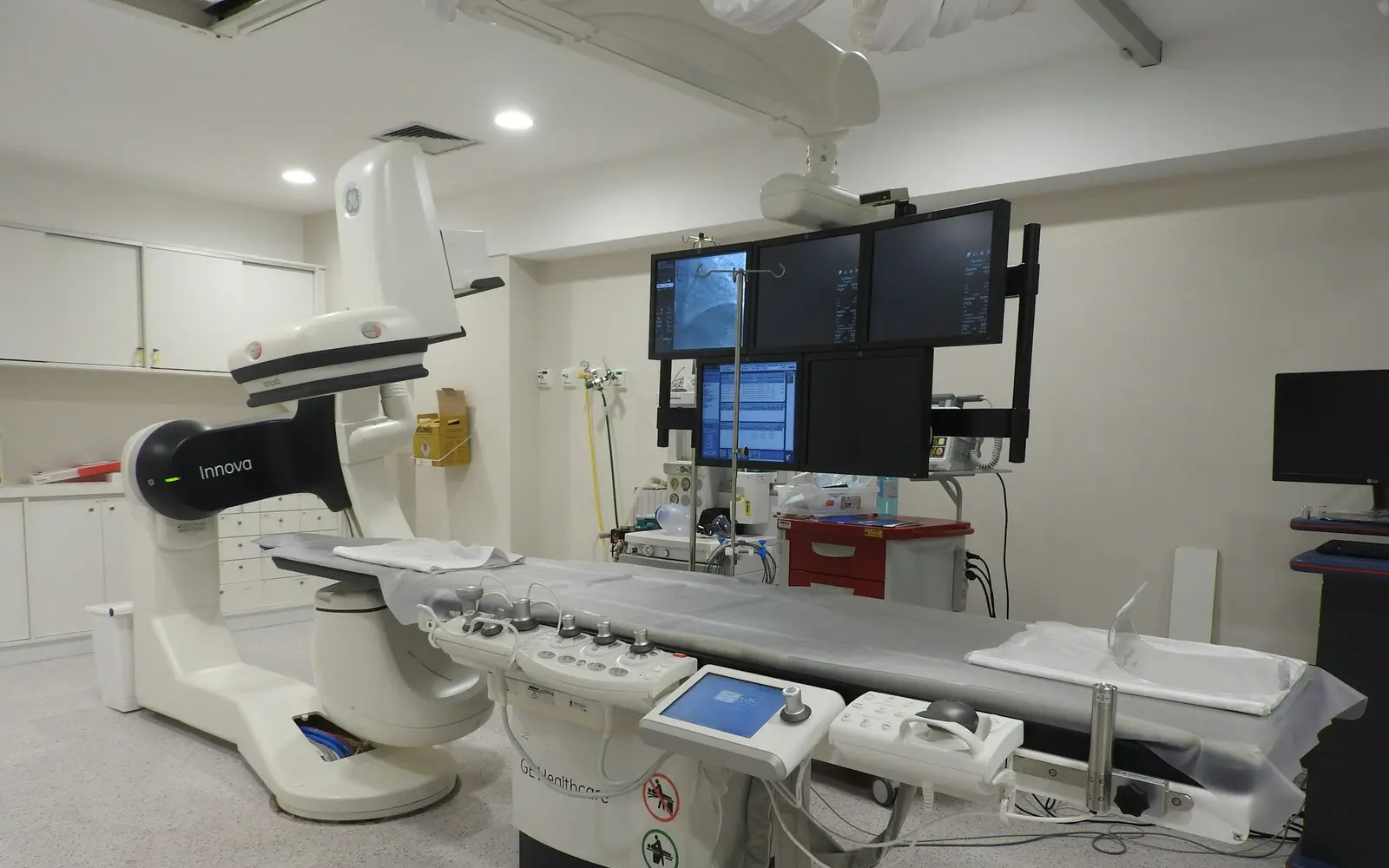
You lie on a table under a large X-ray camera, awake but relaxed with sedation. The cardiologist numbs the wrist (radial artery) or the groin (femoral artery). Wrist access is common now, because people can sit up and walk soon after. A thin wire is passed across the narrowing, the balloon opens it, and the stent is expanded into place.
For hard, calcium-filled narrowings, the cardiologist may use extra tools, such as a tiny rotating burr or a balloon that sends sound pulses to crack the calcium. Some teams use imaging from inside the artery, or a pressure wire that measures whether a narrowing really limits blood flow. The procedure takes from about 30 minutes to two hours, depending on how many arteries are treated.
Recovery and how long you stay
If the wrist was used, a tight band is placed over the puncture and slowly loosened over a few hours. You can usually sit up and eat soon after. If the groin was used, you lie flat for several hours so the artery seals, sometimes helped by a small closure device. There are no stitches to remove, only a small puncture mark that heals within days.
Most people stay one night, and some two or three, particularly after a recent heart attack or a complex procedure. Plan on 5 to 8 days in total in the country where you are treated. That allows for tests, the procedure, the hospital stay, a check with the cardiologist and a day or two of rest before the flight. People who had a planned, uncomplicated procedure are often allowed to fly within a few days, and your cardiologist will confirm the date.
For the first week, cardiologists usually advise against lifting heavy bags or strenuous exercise, and ask you to keep the puncture site clean and dry. Your own cardiologist will give you the exact limits. Small bruising is normal. A growing swelling, bleeding that does not stop with pressure, or a cold or numb hand or leg needs a doctor straight away.
The medicines matter most
After a stent, you take two antiplatelet medicines, usually aspirin plus clopidogrel, ticagrelor or prasugrel, for several months. These stop clots forming in the stent while it heals into the artery wall. Missing doses is risky. Before you fly, check that the same medicine is sold in your home country, and carry enough for the trip plus extra days in case of delays. Your MediCurage coordinator can go through the prescription with you on a video call, with the interpreter beside you, tablet by tablet.
Statins (cholesterol medicines), blood pressure control, stopping smoking and regular walking keep the rest of the arteries healthier. A stent fixes one narrowing. It does not stop the disease elsewhere.
Questions to ask your doctor
- Which arteries are narrowed, and which will you treat?
- Would bypass surgery be a reasonable alternative in my case?
- Will you go through my wrist or my groin?
- Which stent do you plan to use, and how does the quote change if I need more than one?
- How long must I take the two blood thinners, and which brands can I buy at home?
- When can I fly, and when should I have my next check?
Ask the same questions of each hospital that quotes for you. If the answers differ, that tells you something useful, and your coordinator can help you set them side by side before you choose. The hospitals do not have to be in the same country. You can name the country you prefer on the quote form, or ask for quotes from more than one.
Indicative cost by country
Ranges for a standard case at a private hospital. They help you plan; your chosen hospital's quote for your case is the figure to plan around.
- IndiaIndicative priceUS$3,500 to US$6,000Hospital stay1 to 3 daysTotal time in the country5 to 8 days
What the range usually covers: Angiogram and angioplasty with one drug-eluting stent, cardiologist fees and a short hospital stay. Each extra stent adds to the cost. Excludes flights and hotel.
- TurkeyIndicative priceUS$4,000 to US$9,000Hospital stay1 to 3 daysTotal time in the country5 to 8 days
What the range usually covers: Angiogram and angioplasty with one drug-eluting stent, cardiologist fees and a short hospital stay. Each extra stent adds to the cost. Excludes flights and hotel.
- ThailandIndicative priceUS$9,000 to US$14,000Hospital stay1 to 3 daysTotal time in the country5 to 8 days
What the range usually covers: Angiogram and angioplasty with one drug-eluting stent, cardiologist fees and a short hospital stay. Each extra stent adds to the cost. Excludes flights and hotel.
- MalaysiaIndicative priceUS$5,000 to US$9,000Hospital stay1 to 3 daysTotal time in the country5 to 8 days
What the range usually covers: Angiogram and angioplasty with one drug-eluting stent, cardiologist fees and a short hospital stay. Each extra stent adds to the cost. Excludes flights and hotel.
- MexicoIndicative priceUS$4,500 to US$16,000Hospital stay1 to 3 daysTotal time in the country5 to 8 days
What the range usually covers: Angiogram and angioplasty with one drug-eluting stent, cardiologist fees and a short hospital stay. Each extra stent adds to the cost. Excludes flights and hotel.
Indicative range. Your final cost depends on your reports and the hospital you choose.
Questions families ask
Will I be awake during angioplasty?
Usually yes. The skin at the wrist or groin is numbed with local anaesthetic and you are given medicine to help you relax. Most people feel pressure rather than pain, and some notice brief chest discomfort while the balloon is inflated.
How many stents will I need?
That depends on how many arteries are narrowed and how long the narrowings are, which the angiogram shows. The cardiologist may give an estimate from your reports, but the final number is decided during the procedure. Ask each hospital how its quote changes if an extra stent is needed.
Can a stent fall out or move?
No. Once the stent is expanded it presses firmly into the artery wall, and over the following weeks the lining of the artery grows over it. It stays in place for life and does not need to be removed.
Do I have to take blood thinners after a stent?
Yes. Most people take aspirin plus a second antiplatelet medicine for several months, often up to a year, and then aspirin or another single medicine long term. Stopping them early can let a clot form inside the stent, so never stop without speaking to your cardiologist.
Can I go through airport security with a stent?
Yes. Coronary stents do not cause problems with airport metal detectors. Some hospitals give you a stent card with the type and size of stent, so keep it with your discharge summary in case a doctor ever needs to know what was done.
This page is general information. Your treating doctor decides your treatment plan.